
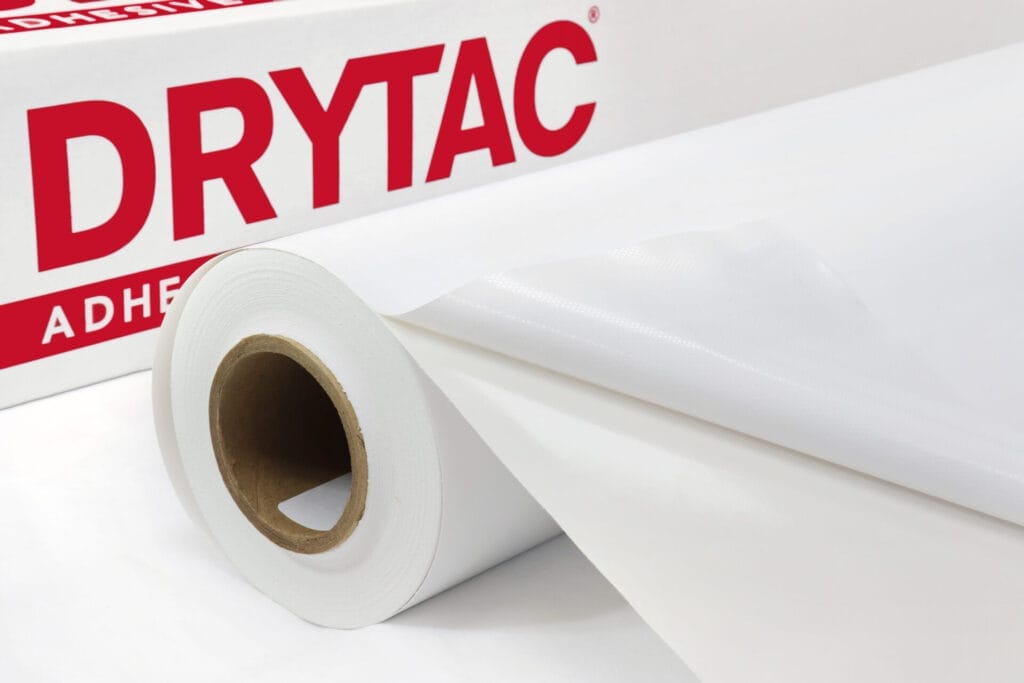
Every Drytac print media page carries a line called Printer Compatibility. It sits between the adhesive type and the durability rating, and it is the fastest filter a print service provider has. Get it wrong and the roll is scrap before the job reaches the laminator.
Most media selection advice starts with the application: window, floor, wall. That is the right second question. The first one is narrower. If the press in your shop cures ink a particular way, a good part of the catalogue is already out, whatever the application calls for.
This is how to read that field, and which Drytac media list which ink technologies.
What the compatibility field is telling you
The field lists the ink technologies a material has been tested against. Drytac’s wording on every product page is the same: the material “has been tested and is compatible with generic print profiles”, and you should refer to your printer manufacturer’s guidelines to identify the most suitable profile. The field is a shortlist, not a colour-managed profile.
Four values appear across the range: (Eco) Solvent, Latex/Resin, UV and Aqueous. Most media list more than one. A few list only one, and those are the ones worth knowing by name.
UV is the widest listing; eco-solvent is the narrowest
Across 27 printable Drytac media checked on drytac.com, every one lists UV. Twenty-five list latex or resin. Twenty list (eco) solvent. One lists aqueous.
The practical reading: if you run a UV flatbed or roll-to-roll, almost nothing in the range is closed to you on compatibility grounds, and your decision moves straight to application and durability. If you run eco-solvent, seven of those 27 materials are not listed for your press, and they are concentrated in the clear films and the PVC-free lines.
Eco-solvent: strong on the polymeric PVC lines
The Polar family is where an eco-solvent shop has the most room. Polar Grip, a 3.2 mil (80µ) phthalate-free polymeric PVC with a grey high coat weight permanent adhesive, lists (Eco) Solvent, Latex/Resin and UV, and carries 7 years interior and exterior with a matching laminate. Polar Frost, the translucent matte embossed polymeric used for etched-glass effects, lists the same three and rates 5 years interior and exterior.
Floor media is the same story. SpotOn Floor 200 — a monomeric PVC with a clear dot-pattern removable adhesive, rated 6 months interior — lists (Eco) Solvent, Latex/Resin and UV. So do Polar Street FX and Polar SandTac Floor. An eco-solvent shop quoting floor graphics is not short of options.
Textured wall media holds up too: ReTac Textures lists all three technologies and rates 5 years interior and exterior.
Latex and resin: where the optically clear films live
Move to glass and the list narrows. ViziPrint Select, the 4.6 mil (115µ) optically clear gloss PET with a removable or permanent optically clear adhesive, lists Latex/Resin and UV only — not eco-solvent. It rates 7 years interior and 2 years exterior. ViziPrint Deco follows the same pattern at 7 years interior and 3 years exterior, as does ReTac Clear PET.
That matters for anyone quoting window graphics from an eco-solvent press. The opaque and translucent window films are open to you; the optically clear PET films, where unprinted areas need to stay genuinely clear, are not.
Two films that list UV alone
Two materials in the set list UV and nothing else.
Polar Blockout UV is a 2.0 mil (50µ) opaque white gloss polyester with a white permanent acrylic adhesive, rated 7 years interior and exterior with a matching laminate. It is the film you reach for when a graphic must not show what is behind it — double-sided window work, or a print going over existing artwork.
SynTac White R is a 2.4 mil (60µ) white gloss polypropylene with a clear removable adhesive, PVC-free, rated 4 years interior and 2 years exterior. If a client brief specifies PVC-free removable and your press is eco-solvent, this one is not a substitution you can make on the day.
The one aqueous listing
PaperTac White Matte is the only material in the set that lists Aqueous, alongside Latex/Resin and UV. It is a 140gsm white matte non-woven paper with a clear permanent adhesive, rated 5 years interior. For an aqueous shop, that is the one entry point into the self-adhesive range.
Media by application, and the presses each one lists
| Material | Application | Printer compatibility | Durability |
|---|---|---|---|
| Polar Grip | Walls, exhibition, long-term | (Eco) Solvent, Latex/Resin, UV | 7 years interior & exterior |
| Polar Frost | Windows, translucent | (Eco) Solvent, Latex/Resin, UV | 5 years interior & exterior |
| ViziPrint Select | Optically clear window | Latex/Resin, UV | 7 years interior, 2 years exterior |
| ViziPrint Deco | Clear window | Latex/Resin, UV | 7 years interior, 3 years exterior |
| Polar Blockout UV | Opaque window, blockout | UV | 7 years interior & exterior |
| SynTac White R | PVC-free removable, vehicle | UV | 4 years interior, 2 years exterior |
| SpotOn Floor 200 | Short-term interior floor | (Eco) Solvent, Latex/Resin, UV | 6 months interior |
| Polar SandTac Floor | Interior floor | (Eco) Solvent, Latex/Resin, UV | 6 months interior (horizontal) |
| ReTac Textures | Textured wall graphics | (Eco) Solvent, Latex/Resin, UV | 5 years interior & exterior |
| Paper Fleece Smooth | Wallcovering | (Eco) Solvent, Latex/Resin, UV | 5 years interior |
| PaperTac White Matte | Recyclable wall graphics | Aqueous, Latex/Resin, UV | 5 years interior |
The overlaminate is chosen separately
Drytac laminating films carry no Printer Compatibility field, because nothing is printed on them. Interlam Pro Matte, Interlam Pro Emerytex and Protac Extreme are selected on finish, hard coat and the durability they add to the printed face, not on your press.
Protac Extreme, for example, is a 6.0 mil (150µ) matte clear textured PET with a hard coating, rated 15 years interior and 5 years exterior. That figure does not change with the press that printed the face film underneath it.
The durability ratings on several print media read “with matching laminate” for a reason. Polar Grip’s 7 years assumes one. Quote the pair, not the face film alone.
Before you order a roll
- Check the Printer Compatibility field first. It is a shortlist, and it removes materials faster than any other spec.
- Check whether the durability rating assumes a matching laminate. Several do.
- Check the face film chemistry against the brief. PVC-free, PET, polypropylene and non-woven paper are not interchangeable even when the compatibility line matches.
- Check the horizontal rating separately on floor media. Polar Street FX and FloorTac Matte White quote different figures for vertical and horizontal use.
- Run the profile from your printer manufacturer’s guidelines. Drytac tests against generic profiles, not against your specific machine and ink set.
How this reads on real jobs
Print Three Calgary used SpotOn Floor 200 on a tennis court floor graphics project — a short-term interior floor material with the widest compatibility listing in the range. Paper Fleece Air went into interior spaces at the Vancouver Design Show. The Brampton Steelheads job paired Polar Premium RB90 with Interlam Pro Matte — face film and overlaminate quoted together, as they should be.
In each case the press came first and the application came second. That is the order the spec sheet is built in.
Next step
If you are matching a material to a press and want to test it before you commit to a roll, request a sample. If you would rather talk it through against a specific job, contact the Drytac team, or find your nearest supplier on the where to buy page.


